
Andrew County Release Date Meaning
A projected date is a calculation, not proof that someone left custody. In an Andrew County jail case, a person held before trial may leave after bond, dismissal, a court order, or another legal event. There is no fixed sentence end to compute while the case is pending. A person serving a county sentence may have an expected end based on the judgment and credited days, but the Andrew County Sheriff does not publish a local computation rule.
State cases use a different vocabulary. Missouri Department of Corrections records may refer to a minimum release date, a conditional-release or CR date, a sentence maximum release date, a presumptive release date, or a time-credit release date. Each term marks a different part of the sentence or release process. The final event can also be parole, conditional release to supervision, maximum expiration, or transfer to another custodian. A later Andrew County release record shows when the person left the county facility, but it does not identify every reason or destination.
Find an Andrew County Release Date
Start with the system that has legal and physical custody. The Andrew County Jail and MODOC keep different records, and neither should be used as a substitute for the other. The county jail is the right source for a local booking and exit. MODOC is the source for the computed dates of a sentenced state prisoner. The court judgment helps explain the term, credit, and later changes, but a docket is not an exit clock.
- Identify whether the person is at the Andrew County Jail, in MODOC custody, or under community supervision. Use a booking number, DOC ID, and date of birth when available to avoid a same-name error.
- For an active state case, search the official MODOC Offender Search. It searches active incarceration, probation, and parole records, includes aliases, and requires CAPTCHA.
- Read the field label exactly. Do not convert a minimum, maximum, conditional, or presumptive date into a guaranteed release date.
- For a county sentence, obtain the judgment and ask the Andrew County Jail for the credited-time and release calculation. For a person awaiting trial, review the court case and bond status instead of expecting a fixed date.
- Confirm the completed event through the originating office. The full Andrew County released inmate search explains how the county record, court case, and later custodian fit together.
The active MODOC search explicitly excludes discharged offenders. No result therefore does not prove that all state obligations ended. For older cases, MODOC’s nightly Sunshine data covers people who are or have been under Department supervision, with records extending as early as 1974. It is a working bulk file, so match the DOC ID, cause number, assigned place, field or institution flag, completed flag, and dates before reaching a conclusion.
Note: A court sentence can explain a release calculation, but only the custodian’s event record confirms the actual physical exit.
Four Missouri Release Date Fields
Missouri’s official field names are more useful than the broad phrase “projected release date.” The MODOC glossary, Sunshine layout, and Parole Board materials distinguish four dates. Their differences matter for an Andrew County person who moved from the jail into state custody.
- Sentence Maximum Release Date
- The maximum or expiration date of the active sentence in MODOC Sunshine data. Special values can represent life, an indeterminate or interstate matter, or an assessment setting.
- Sentence-I Minimum Release Date or CR Date
- The calculated minimum or conditional-release date. It reflects statutory sentence structure, not a promise of parole or release to the community.
- Presumptive Release Date
- A date set by the Missouri Parole Board. It remains subject to requirements and possible rescission before release.
- Time-credit Release Date
- A Blue Book term for a conditional-release date adjusted by credit that has been granted under the applicable rules.
The live offender-search landing page describes active people under MODOC supervision but does not promise that every result uses a field literally named “Projected Release Date.” Copy the label seen on the matching record. If the meaning remains unclear, an institutional caseworker, probation or parole field officer, or MODOC Constituent Services is a better source than a hand calculation.
The official Missouri corrections glossary shows the terminology used for minimum and conditional release dates.
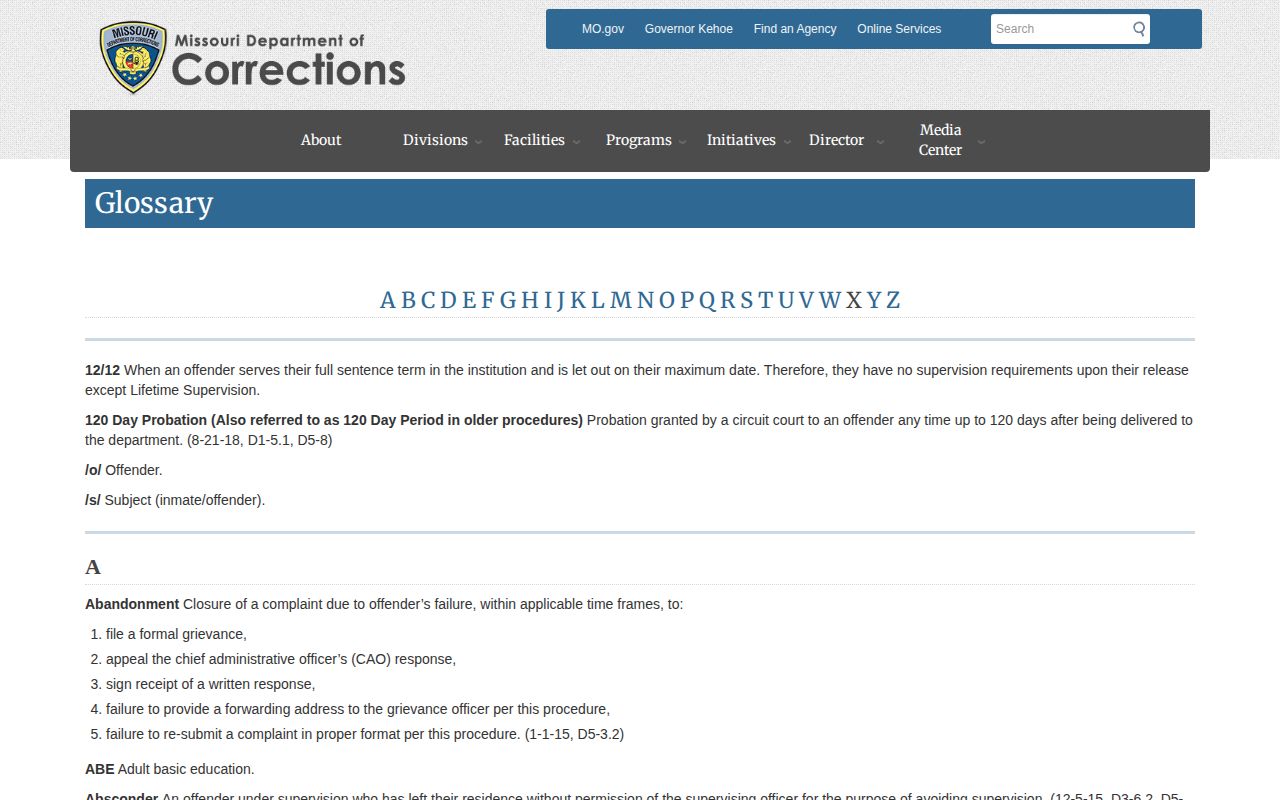
The glossary helps identify what a date means before it is compared with an Andrew County jail exit or court record.
Andrew County Conditional Release Terms
RSMo 558.011 divides many Missouri terms-of-years felony sentences into a prison portion and a conditional-release portion. For a sentence of nine years or less, the conditional portion is one-third. It is three years for a sentence longer than nine through fifteen years, and five years for a sentence longer than fifteen years. The remainder is the prison term. These fractions describe sentence structure. They do not establish discretionary parole eligibility or guarantee release on a date reached with simple arithmetic.
A conditional release ends confinement but starts the supervised part of the sentence. Parole differs because the Parole Board makes a discretionary release decision. Probation is court-ordered community supervision and may begin without a completed prison term. All three states can keep someone visible in MODOC’s active search after secure custody ends. Final discharge occurs only when the Department’s sentence and supervision relationship is complete.
The Missouri statute is visible on the official conditional-release terms page.
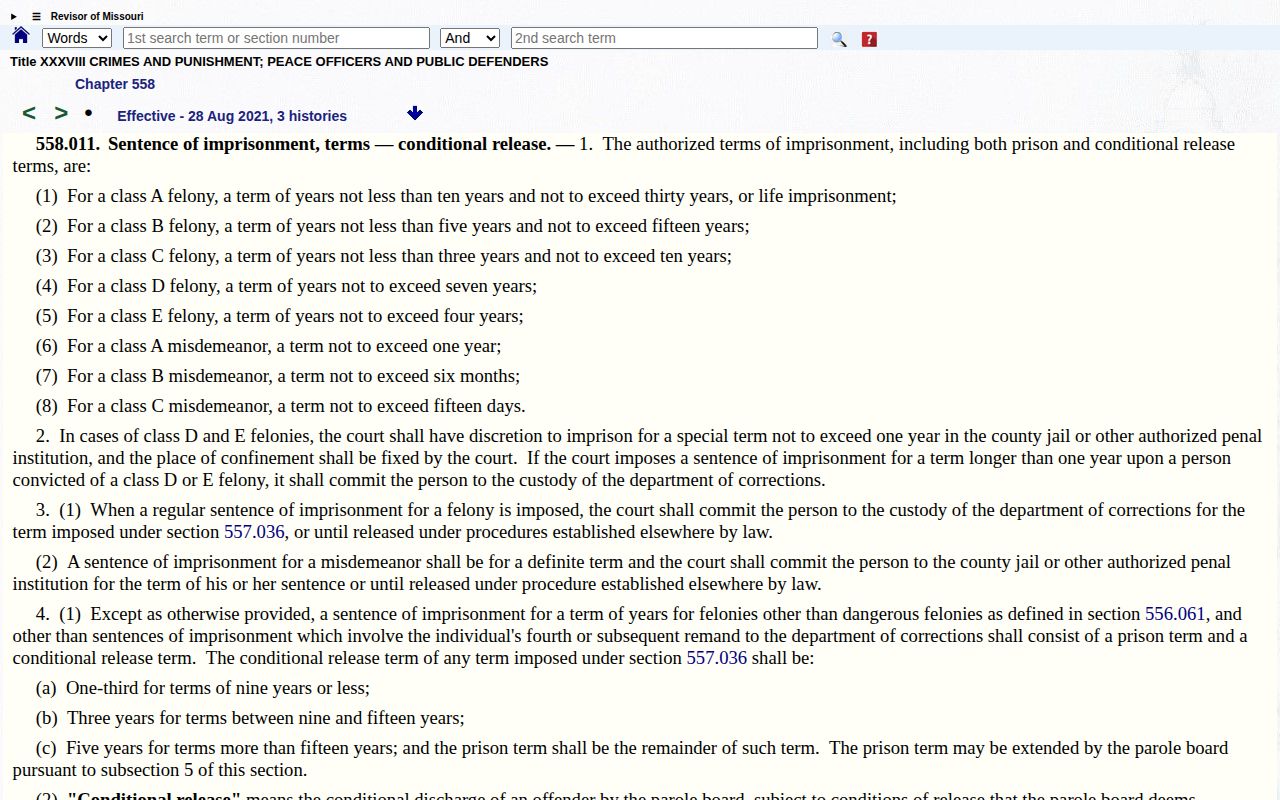
Read the statute with the judgment and MODOC calculation because covered offenses and sentence details can change how the rule applies.
Missouri Minimum Release Percentages
Some Missouri sentences have minimum prison terms before eligibility for parole, conditional release, or another early release. RSMo 558.019 applies its detailed rules to the offenses listed in that statute. For covered non-dangerous felonies, one prior prison commitment can require 40 percent, two unrelated commitments can require 50 percent, and three or more unrelated commitments can require 80 percent. A dangerous felony generally carries an 85-percent minimum, subject to the statute’s age-70 alternative when it applies.
For this calculation, the law treats life as thirty years and certain aggregated terms as seventy-five years. The resulting percentage is a floor for eligibility, not a Board promise. Offense classification, prior commitments, consecutive terms, and other statutes must be confirmed from the judgment and official sentence record. A calculator that lacks those facts can produce a date that looks exact but has no legal force.
The official minimum-term statute is the source for those percentages and covered conditions.
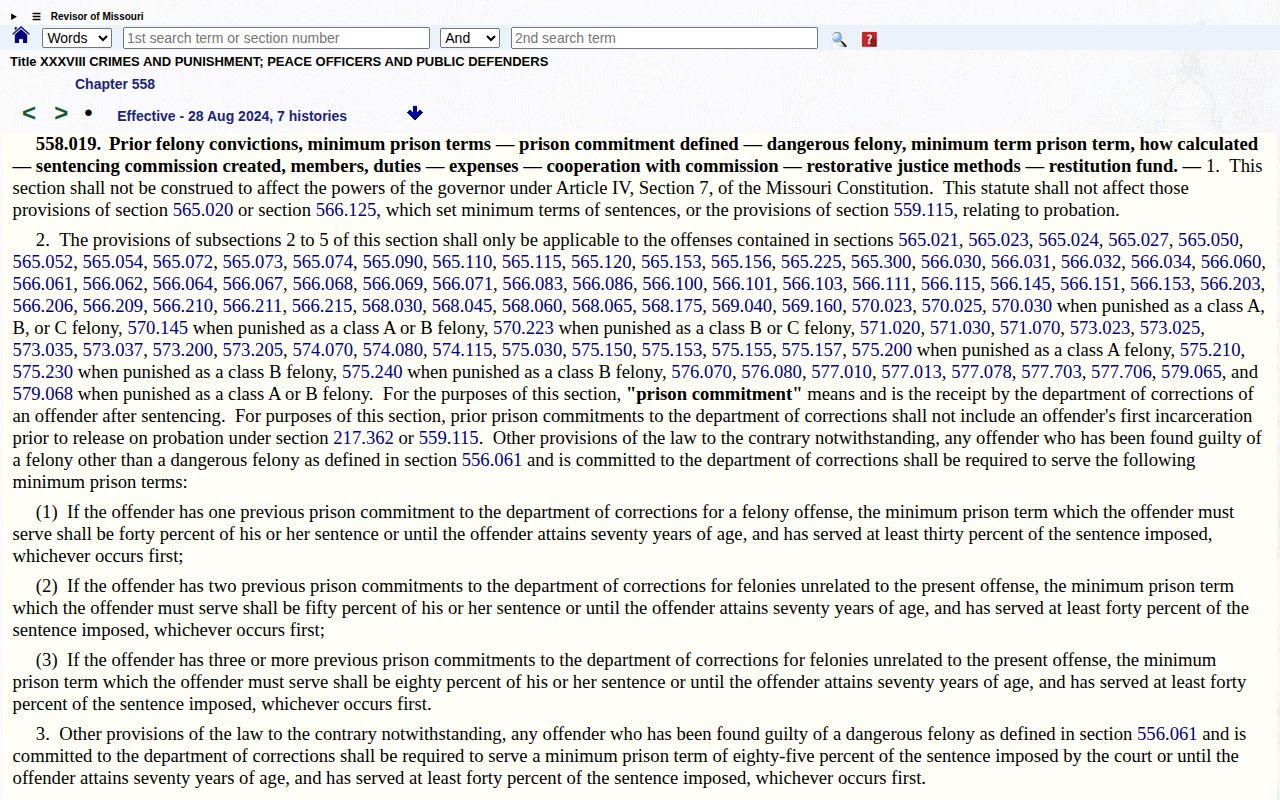
Note: Minimum-term percentages establish eligibility limits, not a firm date when an Andrew County prisoner will walk out of custody.
Andrew County Sentence Credit
Missouri “good time” is not an automatic discount. RSMo 558.041 permits eligible Department offenders to receive added days of confinement credit on a superintendent’s recommendation and under Department rules. Orderly conduct and use of rehabilitative programs may support credit. The credit can be rescinded, applies to the sentence then being served, and excludes categories named in the law. A conduct violation can move a time-credit calculation later.
RSMo 558.031 separately governs qualifying credit for time already spent in custody. Custody dates and credit information accompany delivery to MODOC. This is why an Andrew County jail stay may affect the Department’s calculation and why sentence-date-plus-term arithmetic can be wrong.
The official additional-credit statute shows both the authorization and its limits.
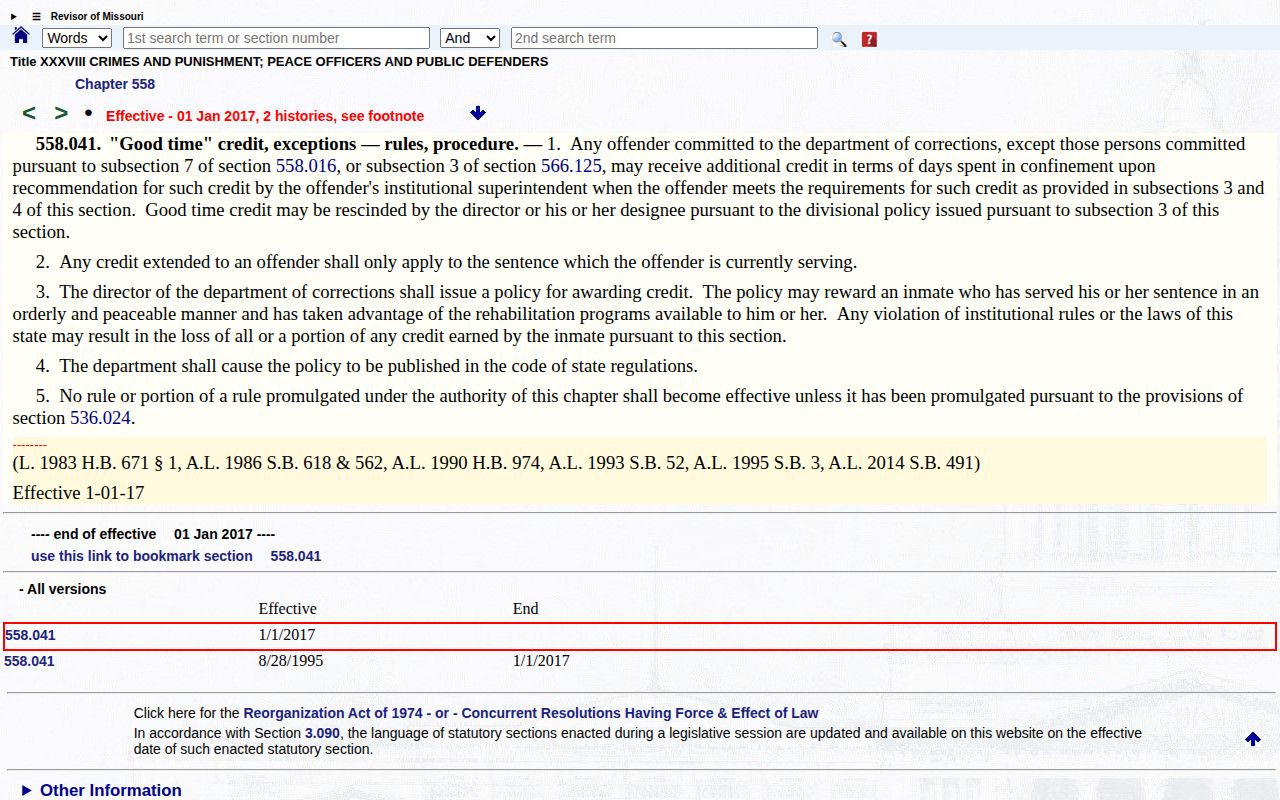
Use the current MODOC record to learn what credit was actually applied in a specific Andrew County sentence.
Why Andrew County Dates Change
A projected release date can move even when the original sentence does not. Some changes alter the calculation. Others prevent a person from returning to the community on the date one custody term ends. The source of the change determines which office can explain it.
| Factor | Effect on the date or release | Best source |
|---|---|---|
| Credit granted or rescinded | Can move a time-credit date earlier or later. | MODOC sentence calculation |
| Corrected jail credit | Changes qualifying time counted before prison delivery. | Judgment, Andrew County jail record, and MODOC |
| Concurrent or consecutive terms | Changes how multiple terms combine. | Court judgment and DOC sentence record |
| Parole Board action | May set, defer, deny, or rescind a presumptive date. | Missouri Parole Board |
| New court order or appeal | May amend the term, stay action, or require recalculation. | Missouri Case.net and court file |
| Detainer or outside hold | May cause transfer when the current custody term ends. | Current and receiving custodians |
The Andrew County released feed records a jail exit time but omits release reason, destination, transfer agency, and confirmation that all holds cleared. A county timestamp can therefore be accurate while a claim of community release is wrong. Check the arresting agency, court matter, and any receiving locator when another government may have assumed custody.
Note: A detainer can end one custody record while beginning another, so an exit date may document transfer rather than freedom.
Andrew County Jail Calculation Limits
No authoritative Andrew County Sheriff good-time formula was found in the July 2026 source sweep. No local early-weekend or holiday-release rule was located either. State prison statutes should not be applied mechanically to a county jail term. Instead, obtain the judgment and ask jail staff which custody days were credited, what event controls the expected end, and whether another hold will cause a transfer.
The Andrew County Jail is at 400 East Main Street in Savannah and operates around the clock. Its public number is 816-324-4114. The online profile warns that charges and bail can change after court appearances and directs readers to detention staff for current amounts, charges, and case numbers. Those cautions also support direct confirmation when the judgment, jail calculation, and web roster do not line up.
A narrow record request can name the person, booking number, and date range, then ask for the booking record, credited-time calculation, release transaction, exact exit time, and public release authority or destination. Missouri’s Sunshine Law requires a response as soon as possible and no later than the end of the third business day under RSMo 610.023. That is a response deadline, not a promise that all records will be produced in three days.
Andrew County Parole Date Checks
A parole eligibility hearing does not guarantee release. The Missouri Parole Board process says the Board may set another hearing one to five years later or set a future release date. It weighs conduct, adjustment, completed and needed programs, and other relevant information. A decision normally takes about eight to twelve weeks. Even a favorable decision can be followed by conditions, a home-plan review, or rescission before the person leaves.
For a pending custody-change event, use the VINE inmate check when the responsible agency participates, then confirm through MODOC or the jail. VINELink is a notice tool, not the sentence calculator. Eligible victims in MODOC matters may have a separate MOVANS route for hearing, decision, scheduled-release, and community-release notice.
Final parole or conditional-release discharge is another distinct date. Under RSMo 217.730, MODOC may issue a final order or certificate of discharge, generally no sooner than three years after parole or conditional release unless the sentence expires first. For a completed state case, that document is stronger proof than disappearance from the active offender search.
Note: “Granted” describes a Board decision, while the later custody record confirms when the Andrew County person actually left confinement.